
Compact USB Cable Testers: Basic Diagnostics for Tech Gurus

Introducing Maria, our meticulous planner and talented visual storyteller. She has a knack for discovering those hidden gems, chic boutique spots, and charming little cafes that add a touch of elegance to every journey. With her keen eye for photography and her passion for travel, Maria will transport you to the most enchanting corners of the world, inspiring you to explore new places, one picture-perfect destination at a time.
Tester? Treedix is 3.5×3.1×0.9 in and lights 24 LEDs to flag voltage, resistance, and shorts on any USB cable. Fast Treedix adds a single LED showing carrier status. For numeric, TRX5‑0816 gives a 2.4‑inch display and resistance readings. Eversame shows voltage and current on an LCD. ChargerLAB handles up to 48 V PD with 24‑pin LEDs. These tools give visual status, so you’re picking the one that suits your needs. Want deeper details? The section has more.
Key Takeaways
- Treedix: 3.54×3.15×0.94 in, 0.32 oz; visible LEDs instantly map pin integrity.
- Fast Treedix: 7.3×5.7×1 cm, 1.76 oz; LED pins reveal continuity, short, open, and polarity errors at a glance.
- TRX5‑0816: 3.62×3.19×0.87 in, 0.09 kg; 2.4‑inch color screen displays resistance, speed, and power metrics, plus charge‑mode status.
- Eversame: 60×60×11 mm, 1.1 oz; LCD shows voltage/current levels up to 30 V/5 A, and eight testing modes for surface‑mount cables.
- ChargerLAB: 53×33×9 mm, 62 g; 24 independent colored LED pins support 48 V USB‑C tests, but lacks numerical resistance timing outputs.
USB Cable Tester Board with Acrylic Case

If you need a quick, reliable way to check every kind of USB cable—from USB‑C and Type‑B to Lightning and Micro‑A—this compact Treedix board in a clear acrylic shell is the tool for you. Measuring 3.54 × 3.15 × 0.94 in and weighing only 0.32 oz, the tester stays lightweight for on‑the‑go diagnostics. It runs on a single CR2032 battery or a 5 V Type‑C input, needing no external power tools. The board’s 24 color‑coded LEDs light up immediately, allowing you to quickly identify continuity, shorts, or data faults right away at a glance. Supported by every USB category, it quickly confirms cable integrity for pros.
Best For: The optimal user is a mobile technician or electronics hobbyist who needs a lightweight, battery‑powered USB cable diagnostic tool that works with all USB standards, including USB‑C, Type‑A/B, Mini‑B, Micro‑A, and Lightning.
Pros:
- Compact and ultra‑lightweight (3.54 × 3.15 × 0.94 in., 0.32 oz) for easy transport.
- Dual power options (CR2032 battery or Type‑C 5 V) for convenience on the go.
- 24 color‑coded LEDs give instantaneous visual confirmation of continuity and faults.
Cons:
- Requires a CR2032 battery, which can be inconvenient if not stocked.
- No digital readout; relies solely on LED status, which is limited for detailed diagnostics.
- Suits only basic verification; does not detect higher‑order performance issues like signal integrity beyond continuity and shorts.

- 【Reliable USB cable tester】: The product can be used to test different types of USB cables, including TypeB 3.0, TypeB 2.0, TypeC 3.0 (TypeC 3.1/TypeC 3.2), MicroB 3.0, MicroB 2.0, MiniB 2.0, for Lightning.
- 【Convenient and practical】: The product features a portable design, compact size, and is easy to carry and use.It's comes with an acrylic case to protect the usb cable tester from damage.
- 【Multiple power supply options】: Supports two power supply modes: CR2032 button battery or Type C 5V to stably supply power to the usb cable tester
- 【LED indicator lights】: Test results are displayed through 24 LED indicators, with each pin corresponding to an LED light.
- 【Multi-functional and practical】: Supports multiple types of interfaces, allowing quick detection of data cable abnormalities and detection of internal short circuits that may interfere with normal operation.
Fast USB Cable Tester for Type-C, USB-A, Lightning

When you’re a tech‑support pro who needs to fix cable clutter fast, the Treedix USB Cable Tester delivers instant visual confirmation with its LED pins that reveal every wire core and line status—whether normal, faulted, or data‑only—without plugging into a phone or computer. You’ll find it compatible with Type‑C, USB‑A 3.0, Micro‑B 3.0/2.0, Mini‑B 2.0, and Lightning, covering USB 2.0, USB 3.2, and PD 3.0/3.1. The tester spotlights normal, faulted, open, charge‑only, data, and high‑speed connections at a glance. Powered by the included CR2032 battery—or via Type‑C 5 V when needed—it stays nimble at 7.3 × 5.7 × 1 cm and 1.76 oz. Keep it handy, and resolve outages instantly when troubleshooting.
Best For: tech support professionals and electronics technicians who need a portable, quick visual diagnostic tool for a wide range of USB and Lightning cables without connecting to a host device.
Pros:
- Rapid visual confirmation of cable integrity via LED indicators.
- Broad compatibility (Type‑C, USB‑A, Micro‑B, Mini‑B, Lightning) across USB 2.0/3.2 and PD 3.0/3.1.
- Lightweight, battery‑powered design ideal for on‑the‑go troubleshooting.
Cons:
- No quantitative data (e.g., resistance, length).
- Limited to a handful of fault categories; may miss subtle issues.
- Small LED panel can be hard to read in low‑light environments.

- 【High-Quality Tester】This USB cable tester is specifically designed to tackle cable clutter, enabling quick identification of various USB cable types. By observing the LED indicators on the test board, users can intuitively determine the number of wire cores and transmission performance.
- 【Extensive Compatibility】Equipped with nearly all mainstream USB interfaces—Type-C, USB-A 3.0, Micro-B 3.0, Micro-B 2.0, Mini-B 2.0, and Lightning cables—this USB cable tester can quickly detect cable status (normal/fault/open circuit/charge-only/data transmission function/high-speed data transmission, etc.).
- 【Efficient Detection】When dealing with piles of tangled cables, this USB-C tester allows you to swiftly distinguish between different USB-C cables. It is particularly suitable for electronics repair, device debugging, cable quality inspection, and similar scenarios.
- 【Dual Power Supply Methods】The USB tester offers flexible power options: it can be powered either by a CR2032 button cell battery or via a Type-C interface (Note: When using Type-C for power, a separate 5V power adapter is required).
- 【Compact Size】With its small form factor measuring just 7.3×5.7×1 cm, this USB tester is highly portable and can be carried anywhere. Please note: This device is intended solely for cable testing and must not be connected to end devices such as smartphones or computers.
USB Cable Tester 2.4″ eMarker, PD Detection

You’ll find the Treedix TRX5‑0816 the perfect tool for technicians who need instant eMarker chip readings on Type‑C cables. With a 2.4‑inch color display and just two buttons, you can quickly toggle between resistance, efficiency, and quality reports, while the rear switch lets you choose between a single AAA battery or a 5 V Type‑C source. Its core diagnostics include continuity checking, internal resistance measurement in ohms or percent, and full PD 3.0/3.1 verification, which is especially useful for troubleshooting USB 3.2 or Lightning cables. The device weighs only 0.09 kg, flanks a compact 3.62×3.19×0.87‑inch chassis, and comes ready‑to‑go with an AAA battery included.
Best For: technicians and electronics hobbyists who need quick, on‑site diagnostics for Type‑C, Lightning, and USB cables, especially for PD 3.0/3.1 and eMarker chip status.
Pros:
- Portable, lightweight (0.09 kg) with a 2.4‑inch high‑resolution color display for clear readouts.
- Dual power modes: single AAA battery or external 5 V Type‑C supply, making it versatile for field use.
- Comprehensive diagnostics: continuity check, internal resistance (ohms or percent), full PD 3.0/3.1 verification, and real‑time speed checks for USB 2.0, 3.0, and 3.2.
Cons:
- Requires Type‑C cables to have an eMarker chip; non‑eMarker cables are not fully supported.
- Limited to a single AAA battery when not powered from a 5 V source, which may drain quickly during intensive testing.
- Lack of wireless connectivity or software integration limits remote data logging or large‑scale testing workflows.

- 【USB Cable Performance Testing】Test USB cable continuity, functionality (charging, data transfer, high-speed signal), and measure internal resistance for power efficiency. Verify ground wire connection to outer shell for cable integrity, safety, and shielding.
- 【Type-C eMarker Chip Reading】Reads eMarker chip parameters in Type-C cables, providing detailed performance information (e.g., maximum current, voltage, data transfer rates) to help users fully understand cable capabilities and ensure safe, efficient device usage.
- 【High-Definition Color Display】 The USB cable checker features a 2.4-inch high-definition color display. With the left white button, you can easily switch between function pages to view real-time detailed status of the cable, including internal resistance, power delivery efficiency, and cable quality. This helps you quickly identify inferior cables.
- 【Wide Compatibility】The usb tester can accurately identify and verify USB cable versions, including USB 2.0 and USB 3.2. It integrates PD 3.0 and PD 3.1 protocol detection functions, enabling quick verification of whether the cable supports the latest PD 3.0/3.1 standards, ensuring the cable meets high-power charging and fast data transfer requirements.
- 【Multiple Power Supply Options】The black button on the left can flexibly switch the power supply mode, and support the use of AAA battery or Type C 5V to stably supply power to the USB tester
Eversame Type C USB Tester LCD Multimeter

This compact Eversame Type C USB tester is ideal for mobile technicians and gadget lovers who need instant, battery‑free monitoring of their chargers and cables. You’ll find it slims to just 60 mm on each side, only 1.1 oz, and it draws power from the USB port itself—no extra batteries required. It covers voltage ranges up to 30 V and currents up to 5.1 A, displaying eight modes—voltage, current, capacity, power, impedance, D+ and D‑ voltages, and more—by a simple button press. The tester auto‑detects QC 3.0/2.0, BC 1.2, and supports USB‑PD fast‑charge on iPhones, Galaxy, Chromebook, and more, delivering vividly quickly LCD data for diagnostics.
Best For: mobile technicians and gadget lovers who need quick, battery‑free USB‑C charger and cable diagnostics.
Pros:
- Ultra‑compact 60 mm × 60 mm × 11 mm design, light as 1.1 oz
- No batteries required; draws power directly from the USB port
- Eight on‑screen measurement modes (voltage, current, power, capacity, impedance, D+/D‑ voltages, etc.)
Cons:
- Limited to a maximum of 30 V and 5.1 A, not suitable for high‑power industrial circuits
- Single‑button interface can be less convenient than multitouch or app controls
- Lacks built‑in data logging or wireless connectivity for record‑keeping and remote monitoring.
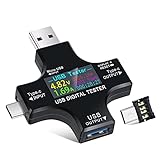
- UPGRADED MULTIFUNCTIONAL USB C POWER METER: Detects the charging status and process of your USB-enabled or type c-enabled devices. Supports QC3.0, QC2.0 and BC1.2. A Must Gadget checks the charging performance (charging speed and quality) of the output wall/car/solar panel chargers and USB charging cables. It can be also used to find the highest current of the Wireless Charger, and test capacity and electric energy of power bank
- PROFESSIONAL SAFETY GUARD: Featured with over-voltage protection, over-current protection, under-voltage protection, low energy protection and alarm system. This upgraded USB Type C tester can detect safety and maximally protect the appliances from damaging. It will cut off output automatically and alarm by sound, while it will save data when power off suddenly
- MULTIPLE COLOR SCREEN DISPLAY MODES: New upgraded version offers 8 LCD main color screen display interfaces, allowing switching the display interface by pressing the key. With the new interface settings, this instrument can monitor voltage, current, capacity, electric quantity, power, load impedance, D+/D- voltage and other data of USB
- WIDE RANGE OF APPLICATION: Thanks to the PD protocol quick charging mode measurement technology, this new multimeter supports the updated iPhone X mobile phone. (Support iphone 8 / 8P / iPhone Xs quick charging, 29W power, 5V3A / 9V3A / 12V2.5A / 15V2A). It also can be applied to test other type C devices, Compatible With Galaxy S10/S9/Note 10 +, ChromeBookPixel, OnePlus and More
- QUALITY COMMITMENT: We always believe in the stability and continuous improvement of product quality. Package includes 1 x USB Tester. (Note: If the USB tester does not show any parameters, please insert the small adapter sent with the package into the side hole of the USB tester to trigger the PD charging function)
ChargerLAB USB-C 24-Pin Cable Tester LED

The ChargerLAB USB‑C 24‑Pin Cable Tester LED, with 24 independent LEDs that map every pin, is an ideal tool for electronics technicians and tech hobbyists who demand quick, accurate checks of USB‑C cables.
You’ll love its compact 53 × 33 × 9 mm chassis, weighing 62 g. It runs on a CR2032 cell, so you can test cables on the go. Each pin lights a distinct LED—color‑coded for continuity, data, and power—so spotting issues is instant. It runs up to 48 V, safely evaluating high‑current PD profiles and displaying USB‑A‑to‑USB‑C data rates. All 24 LEDs illuminate in real‑time, giving you visual confirmation of each pin’s health.
Best For: Electronics technicians, repair shop professionals, and tech hobbyists who need quick, detailed, on‑the‑go diagnostics for USB‑C cables.
Pros:
- 24‑pin LED array offers instant, color‑coded status for continuity, data, and power.
- Compact, lightweight (53 × 33 × 9 mm, 62 g) and battery‑powered for true portability.
- Supports up to 48 V and shows USB‑A‑to‑USB‑C data rates for comprehensive PD checks.
Cons:
- Relies on a single CR2032 battery, requiring replacement if used heavily.
- Limited to USB‑C cable testing; not applicable to other USB types or connectors.
- Provides visual readout only; subtle impedance or timing issues may go undetected.

- 【Full 24-Pin Continuity Detection】Supports complete USB-C pin testing with 24 LED indicators, helping you instantly identify faulty or missing connections.
- 【Power Delivery Compatibility】Accurately checks cable continuity for charging pins, ensuring reliable charging performance.
- 【Data Transfer Verification】Detects whether your cable supports data transmission and how fast can it be.
- 【Portable & Battery-Powered】Compact design (53×33×9mm, 17.8g) powered by a CR2032 button cell, no external power required — perfect for on-the-go cable testing.
- 【Easy-to-Read LEDs & Broad Compatibility】Independent LEDs for each pin group clearly display continuity results for fast and intuitive diagnostics. Supports USB-C to USB-C cables and, with the included USB-A female to USB-C male adapter, USB-A to USB-C cables.
UT01C USB C Cable Tester (PD/QC)

If you’re an engineer or hobbyist who needs instant, accurate voltage, current, and power readings for USB‑C cables, the POROMETISTO UT01C delivers a 5 MHz sampling capacity and a 10 kHz refresh rate in a pocket‑sized 4.8 × 3.27 × 0.87‑inch, 2‑ounce device. Its slender purple case measures 4.8 × 3.27 × 0.87 inches and weighs just 2.1 ounces, CE‑certified and bilingual in English and Chinese. You’ll capture DC voltage up to 30 V, currents up to 12 A, and power outputs up to 240 W while the 5 MHz ripple analysis keeps accuracy sharp. It auto‑detects PD and QC protocols, spoofing PDOs when needed, and offers a dimmable display, with smart power‑off memory.
Best For: engineers, technicians, and electronics hobbyists who need a compact, high‑precision USB‑C cable tester for real‑time voltage, current, and power measurements.
Pros:
- 5 MHz ripple analysis and 10 kHz refresh rate deliver precise, instant readings.
- Auto‑detects PD, QC, PPS, and other fast‑charging protocols with spoofing capabilities.
- Lightweight 2 oz purple design with a dimmable IPS display, making it ideal for field use.
Cons:
- Limited battery capacity for extended out‑of‑the‑bag use; frequent recharging needed.
- No Bluetooth or Wi‑Fi connectivity for remote logging or data transfer.
- Only basic English/Chinese menu labels—no expanded language support.

- Comprehensive and Accurate Electrical Parameter Testing: The POROMETISTO UT01C USB tester supports real-time measurement of DC voltage (3.3-40V), current (0-12A), and power (up to 240W). It accurately displays key data such as voltage, current, power, capacity, and temperature. This USB-C cable tester also features ripple analysis, current direction indication, and real-time range switching, meeting the in-depth testing needs of professional users for USB-C devices.
- Extensive Compatibility with Fast Charging Protocols and Intelligent Spoofing: The UT01C USB-C tester fully supports multiple fast charging protocols, including PD2.0/3.0/3.1 (including AVS/EPR), QC2.0/3.0/4.0+, PPS, and BC1.2. This USB port tester supports PDO/QC gear spoofing, E-marker simulation, and private protocol triggering. The UT01C USB digital tester can proactively test and analyze protocol gears, helping users maximize the potential of charging devices.
- Battery Capacity Statistics and Data Storage: The built-in capacity test module records cumulative battery capacity (mAh) and energy consumption (Wh), and supports power-off memory. This USB power tester also provides maximum voltage, current, and power recording, and combines with temperature monitoring, making it ideal for performance evaluation of batteries, power banks, and power supplies.
- Multi-mode graphical analysis: Equipped with curve plotting, ripple measurement, and protocol auto-testing functions, supports real-time spectrum display and data pause analysis. A high 5MHz sampling frequency combined with adaptive curve units accurately captures dynamic current and voltage changes, facilitating power quality analysis and troubleshooting.
- User-friendly design and versatile operation experience: The color IPS display, gravity rotation, and 10kHz dimming. It offers pass-through mode, key shortcuts, brightness adjustment, and an automatic screen saver. The POROMETISTO Type C USB tester also includes advanced features such as protocol combination testing and data I/O voltage display, making it suitable for a variety of scenarios for engineers, maintenance personnel, and electronics enthusiasts.While meeting your own needs,it is also a great gift for your friends and family.
UMLIFE 2-Pack DT3 USB‑C Cable Detector

Looking for a quick way to make sure your USB‑C cables are wired correctly? The UMLIFE 2‑Pack DT3 gives you a compact, 5 × 5 cm PCB tester that spots data‑line issues instantly. It supports Type‑C, Type‑A, and Micro‑USB inputs, and its five LEDs—VCC, GND, D+, D–, and CC—light up when everything lines up. Plug a charging cable into the power port, insert each cable end into matching ports, and watch the panel: a full glow signals a proper wire, while missing lights flag a fault. With two boards, you can test Type‑C‑to‑C, Type‑C‑to‑Lightning, and more for checks in your tech setup.
Best For: tech enthusiasts, electronics hobbyists, and IT professionals who need to quickly verify USB‑C cable wiring.
Pros:
- Compact 5 × 5 cm size and lightweight design.
- Instant visual confirmation with five LED indicators for VCC, GND, D+, D–, and CC.
- Comes with two boards, supporting a wide range of USB‑C, USB‑A, and Micro‑USB test scenarios.
Cons:
- Requires an external power source; no built‑in battery.
- Needs a separate charging cable to power the tester.
- Relies on visual LED inspection—no digital readout or logging capability.

- D+ or D- is off, indicating the data transmission function is abnormal.Port:Type-C, Type-A, Micro
- Made of high quality materials and stable structural design, the USB Cable Tester provides excellent performance and long service life, ensuring you reliable testing in any situationThe product features a portable design, compact size, and is easy to carry and use.
- Insert the test cable into the corresponding input port after connecting the power from the power supply port 4 lights are on for normal power on, no light is on for abnormal power on (5 lights are on for normal dual-type-c connection).
- With powerful data cable pass-through detection function, it supports C-type, micro and iOS interface inputs to ensure your data cable functions properly.
- Package : You will get 2x USB data cable test board.
USB Type-C Cable Tester Board

For anyone who needs a quick, reliable way to verify USB‑C cables, this compact tester board gives you diagnostics straight at the connector. It’s a PCB from Jizlan that accepts Type‑C and USB data lines. Plug the cable ends into its ports, and you see whether the cable supports data transfer, power delivery, or contains a broken wire. The board’s 4.76×3.15×0.28‑inch, 0.352‑oz footprint keeps it on workbench or in your pocket. LED indicators display pass/fail without software. Jizlan launched the unit in March 2025, earning a top‑hundred‑thousand rank and cementing it as go‑to tool for developers and technicians alike.
Best For: designers, electronics technicians, and hobbyists who need a quick, no‑software way to check USB‑C cable data, power, and fault integrity.
Pros:
- Compact, lightweight design fits easily on a workbench or in a pocket.
- Clear LED indicators provide instant pass/fail visual feedback without extra software.
- Supports both USB‑C and standard USB data lines, making it versatile for various cable types.
Cons:
- No advanced diagnostics (e.g., resistance or voltage measurement) beyond basic LED status.
- Requires manual connection of cable ends; unsuited for bulk cable testing.
- Lacks a user manual or detailed troubleshooting guide in the bundle.

- COMPATIBILITY: Universal USB tester board designed for testing Type-C cables and standard USB data lines for proper connectivity and charging functionality
- TESTING FEATURES: Checks both data transfer and charging capabilities of USB cables, helping identify faulty wires or connection issues
- DESIGN: Compact PCB board in black finish with clear indicators for quick and easy cable testing results
- FUNCTIONALITY: Tests individual wire connections, power delivery paths, and data line integrity for USB cables
- USAGE: Simply connect cable ends to the testing board ports to instantly verify cable performance and identify potential issues
FNIRSI USB Power Tester 4-28V 7A LCD

Need accurate, real‑time voltage, current, and power readings for USB, micro‑USB, or USB‑C cables? The FNIRSI FNB58 gives you that. With a 2‑inch TFT LCD, it displays voltage, current, and power in six digits, while a 16‑bit ADC delivers precise measurements from 4 V up to 28 V at 7 A. Its dual‑port layout supports USB‑A, Micro‑USB, and USB‑C, and you can monitor fast‑charge protocols like QC 3.0, PD 3.0, VOOC, and more. The device records ripple up to 4 MHz, plots waveforms, and logs startup temps. All features run on a lightweight battery, staying under 1.6 oz, providing reliable diagnostics during on‑the‑go evaluations for your workshop.
Best For: electronics hobbyists, repair technicians, and product developers who need portable, on‑the‑go USB charging diagnostics with real‑time voltage, current, and power readouts.
Pros:
- Dual‑port design supports USB‑A, Micro‑USB, and USB‑C in a single compact unit.
- 2‑inch TFT LCD with 6‑digit precision displays, offering clear, immediate data.
- Built‑in battery and lightweight (1.6 oz) for field testing without external power.
Cons:
- Maximum measurement range limited to 4 V–28 V @ 7 A, which may not cover all high‑power applications.
- Battery must be recharged or swapped out for prolonged use, adding a small maintenance step.
- While it logs ripple up to 4 MHz, it lacks higher‑frequency oscilloscope capability beyond 100 Hz waveform capture.

- 【Multi-port USB tester】FNIRSI FNB58 has a 2.0-inch TFT LCD display, integrated USB-A, Micro-USB, Type-C interface. It is a USB voltage and current detection meter with APP software, a mobile communication terminal with gravity sensor and a fast charging trigger
- 【Multifunction USB Digital Tester】FNB58 uses external 16-bit ADC, PD protocol physical chip. FNB58 USB tester can monitor the voltage, current, power, resistance, capacity, D+/D- voltage etc, it can be used to test the fast charging protocol of chargers
- 【Fast Charge Protocol Trigger Detection】FNB58 supports QC2.0/QC3.0, FCP/SCP, AFC, PD2.0/3.0, VOOC/WARP, Super VOOC 1.0/2.0 trigger. The above protocols all support automatic monitoring. MTK-PE automatic detection. Support QC2.O->PD2.0 protocol conversion
- 【Parameter Recording】 Six-digit display of voltage, current and power. 10 sets of switchable capacity, power etc. Support low-speed waveform drawing, 2 sps-100 sps sampling rate. Support ripple drawing, up to 4 M sps sampling rate
- 【USB tester detection function】The resistance measurement of the wire by the differential pressure method. E-Marker Cable chip reading. DASH Cable data reading. Record of startup time. Onboard temperature measurement. PD monitor. Analog DASH cable
USB-C Power Meter & Tester (KWS‑2303C)

With its ultra‑compact design and high‑precision digital readout, the YEREADW KWS‑2303C lets you track voltage, current, power and even device temperature in real time—exactly what gamers, tech enthusiasts, and test‑lab professionals need to guarantee ideal charging performance. Its 4‑30 V voltage window and 0‑12 A current range cover every charger, phone, tablet, or power‑bank you own, while the ±1 % + 5 accuracy keeps data trustworthy. The display, a 1.06″ color screen, shows voltage, current, power, capacity, energy, time, maximums, current direction, and CPU temperature, letting you spot anomalies instantly. Tap a key for view, rotate, or long‑press to plot curves, essential diagnosing quirks. Its lightweight, 1.37‑oz body and CE‑RoHS compliance make it a safe lab staple today.
Best For: Gamers, tech enthusiasts, and test‑lab professionals seeking precise USB‑C charging metrics.
Pros:
- Accurate ±1% + 5 measurement across a 4–30 V voltage window and 0–12 A current range.
- Compact 1.06″ color display with real‑time data and curve-plotting for diagnostics.
- Supports a wide array of fast‑charging protocols (PD 2.0/3.0, QC 2.0/3.0, VOOC, FCP, etc.).
Cons:
- Only measures USB‑C devices; not applicable to older USB‑A or HDMI/Lightning cables.
- No wireless connectivity, limiting remote monitoring or integration with apps.
- Small screen may be challenging in low‑light or at a distance, requiring close inspection.

- Improved Measurement Accuracy: Our USB C Tester can accurately measure accuracy: ± (1%+5). The data is more accurate for detecting charging devices such as chargers, mobile phones, tablets, and power banks. Make this Type-C meter suitable for more 3C digital peripheral products, making it the first choice for digital gamers and electronics enthusiasts.
- Wide Applicability: This USB power meter is equipped with a 12A high current terminal, which is more stable. Measuring current: 0-12A; measuring voltage: 4V-30V. The wide test range makes this USB meter suitable for more 3C digital peripheral products, and it’s a cost-effective solution for anyone looking to optimize their electronic devices’ charging performance.
- Detect Various Fast Charging Protocols: The USB power meter supports PD2.0/3.0, QC2.0/3.0, FCP. SCP, AFC, PE, DASH VOOC and Super VOOC protocol charging. Whether you’re testing chargers, power banks, or any USB-C device, this tester is up to the task.
- Upgraded Curve Function: This USB C tester has upgraded curve function to better record real-time voltage and current. You can set the time of curve page (5mins/15mins/60mins/2hrs) by long press button to monitor the real-time voltage and current. In addition, the voltage and current of each cell will be automatically adjusted according to the actual voltage and current.
- ISP Color Display Interface: This USB C Power Meter features a 1.06-inch ISP color high-definition display with high resolution and clarity. It can display voltage, current, power, capacity, energy, time, maximum voltage, maximum current, maximum power, current direction, and CPU temperature. You can easily switch between interfaces by pressing a key. Double-click the button to rotate the displayed content.
Gikfun USB Cable Tester Board Type-C/Micro/RJ45

You’ll get instant visual confirmation across USB 3.2, 3.1, 3.0, Type‑C, Micro‑AB, Lightning, and Ethernet connectors—each pin maps to its own LED in the 24‑LED panel. This compact tester runs from 5 V–12 V DC and weighs just 2.08 oz, making it ideal for on‑site debugging. Its 3.78 × 2.72 × 1.26‑inch board checks continuity on all USB, Lightning, and 8‑core Ethernet wires. With dedicated indicators per pin, you instantly spot miswiring or shorts. You’ll quickly validate data rates up to 1 Gbps and confirm proper power delivery, ensuring flawless cable performance. The LED colors quickly indicate pass or fail, helping you troubleshoot without tools.
Best For: technicians and repair professionals needing fast, on‑site verification of USB, Lightning, and Ethernet cables.
Pros:
- Quick, visual confirmation via a 24‑LED panel with each pin mapped to its own LED.
- Detects a wide range of connectors (USB 3.2/3.1/3.0, Type‑C, Micro‑AB, Lightning, RJ45) and tests 8‑core Ethernet continuity.
- Light weight (2.08 oz) and compact (3.78 × 2.72 × 1.26 in) for easy portability.
Cons:
- Limited to 5 V–12 V DC power input; lacks battery operation for completely portable use.
- Supports up to 1 Gbps Ethernet; no testing for higher speeds such as 10 Gbps.
- No detailed software interface—depends solely on LED indicators for results.
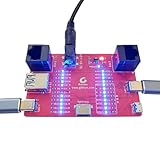
- Interface Type Identification: This tester is a professional tool designed to quickly identify USB cable types (USB 3.2/USB 3.1/USB 3.0/Type-C/Micro-AB/Lightning/RJ45 connector)
- RJ45 Connector Testing:Supports 8-core network cable continuity testing (displays the status of each wire via indicators).Compatible with 100Mbps/1000Mbps network testing.
- Convenient and practical: The product features a portable design, compact size, and is easy to carry and use.Connect the tester to a DC 5V-12V power source.
- LED indicator lights: Test results are displayed through 24 LED indicators, with each pin corresponding to an LED light.
- Multi-functional and practical:It is suitable for Cable Performance Testing, scenarios such as electronic repair, device debugging, and cable procurement.
Diymore USB Power Meter Tester

The Diymore USB Power Meter Tester gives you clear, real‑time readouts of voltage, current, power, and accumulated energy consumption right on its color LCD screen, so you can instantly spot any anomalies in your USB‑C or USB‑A cables. It measures up to 6.5 A and 4 V–30 V, supports PD 3.1, and remains accurate from 32 °F to 140 °F. Designed for quick plug‑and‑play with cables, chargers, power banks, and USB‑powered devices, it keeps all needles in view on a tight 3.5 in × 0.8 in × 2.5 in frame that weighs just 0.317 oz. Brown, compact, and dependable—perfect for nerd‑friendly diagnostics to confirm device safety and performance successfully.
Best For: this USB power meter is best for electronics hobbyists, tech enthusiasts, and IT professionals who need to monitor and troubleshoot USB‑C and USB‑A cable performance in real time.
Pros:
- Accurate real‑time voltage, current, power, and energy readouts help quickly spot anomalies.
- Ultra‑compact, lightweight design plugs straight into cables and chargers for quick plug‑and‑play.
- Wide voltage range (4 V–30 V), 6.5 A current measurement, and PD 3.1 compatibility cover most USB‑powered devices.
Cons:
- No built‑in data logging or remote connectivity; information is only displayed on the small LCD.
- Small color screen can be hard to read in bright or high‑contrast lighting conditions.
- Supports only USB‑C and USB‑A; not compatible with older USB types or specialized protocols.

- REAL-TIME MONITORING: Features color LCD display showing voltage, current, power, energy consumption, and charging time data for comprehensive USB device testing
- HIGH CURRENT CAPACITY: Supports up to 6.5A current measurement with straight-through charging power test capability for accurate readings
- VERSATILE COMPATIBILITY: Works with various USB devices including power banks, chargers, and cables to measure voltage range, amperage, and power output
- DETAILED MEASUREMENTS: Displays multiple parameters simultaneously including voltage (V), current (A), power (W), and accumulated power consumption
- COMPACT DESIGN: Portable USB testing device with plug-and-play functionality for easy connection between power source and device being tested
USB Cable Tester LED Lights for Fast Detection

When diagnosing USB cables on the fly, the tester’s LED indicator system lets you instantly see normal versus fault conditions, making it ideal for technicians who need rapid validation without specialist tools. This compact board measures 45 × 45 mm, yet it supports Type‑C, Small USB, and standard USB connectors. Plug it into your power and device ports, and the blue‑finishing LEDs instantly light up: green means all lines are good, red flags continuity or voltage issue. You don’t need technical skills, and the 1.06‑oz device is lightweight enough for on‑the‑go field work. Floweringbeter’s model 2EDH3O4U0C2NPZ3E857F5CXD14 comes with a manufacturer today warranty.
Best For: technicians and gadget enthusiasts who need quick, on‑the‑go verification of USB Type‑C, Mini‑USB, and standard USB cables without specialized tools.
Pros:
- Instant visual diagnostics with LED indicators cut testing time.
- Supports multiple connector types (Type‑C, Mini‑USB, standard USB) for broad compatibility.
- Compact size and only 1.06 oz. make it lightweight and portable.
Cons:
- Lacks detailed voltage or current measurements; only basic continuity checks.
- Designed for single‑cable testing; cannot evaluate multiple cables at once.
- No polarity detection, so fails to identify polarity‑related issues.

- [USB CABLE TESTER] Efficiently detects charging and data transfer problems in various cables, your devices function optimally.
- [MULTI PORT COMPATIBILITY] Compatible with Type C, Small USB, and USB connectors to test numerous cable types with ease.
- [LED INDICATOR SYSTEM] Utilizes visual lights to provide clear indications of connection status, simplifying the troubleshooting process for users.
- [COMPACT DESIGN] Easy to carry due to its small size, for technicians or anyone needing quick access to cable testing tools.
- [SIMPLE OPERATION] Just connect it to power and device ports; no technical skills required for effective use.
diymore USB C Power Meter Multimeter LED Display

How quickly can you gauge your USB‑C charger’s performance? With the Diymore USB‑C Tester Power Meter, you get instant voltage, current, and power readouts right on a bright LED display. It covers 4 – 30 V and 0 – 6.5 A with ±1 % accuracy, meeting NIST/EN 61010‑1 standards. The 14‑cm Type‑C V3.0 cable plugs directly into your device, while the 5.68 × 2.58 cm body keeps measurements in hand. Beyond volts and amps, the meter records temperature, resistance, and charging time, storing data even when powered off. Whether testing phones, power‑banks, or flash drives, it delivers reliable diagnostics every time. Additionally, it also connects via Bluetooth for remote monitoring.
Best For: tech enthusiasts, mobile phone users, and repair technicians who need quick, accurate monitoring of USB‑C device power needs.
Pros:
- Instant, on‑screen voltage, current, and power readouts with ± 1 % precision.
- Built‑in data logging and Bluetooth support for remote monitoring.
- Compact, lightweight design that stays handy during field tests.
Cons:
- Limited to the 4–30 V, 0–6.5 A USB‑C range; not suitable for higher‑power equipment.
- Relatively small LED display may be hard to read from a distance.
- Single data‑set retention may not meet extensive long‑term logging needs.

- The current and voltage charging tester supports voltage 4-30V, 0-6.5A test voltage.
- The size of the USB tester is 5.68*2.58cm (2.24*1.02inch) with a 14cm Type C extension cable.
- Multi-function: This USB tester is designed to detect voltage, current, capacity, electric quantity, power, temperature, resistance, charging time and other data of the USB C devices, which is convenient for testing power supply and quality.
- The charging tester supports multiple sets of test data saving, and the power failure saving function does not affect the data transmission.
- The Type C voltage tester can measure the power supply or power consumption of USB interface, cell phone charger, USB flash disk and other products, easy to measure the working voltage and current of USB port and device output voltage.
USB Cable Tester LED Type-C & USB

Need to verify connectivity on the go? The USB Cable Tester LED Type‑C & USB offers a compact single‑board solution. Plug in any Type‑C, small USB, or standard USB cable, power the board, and let the LED indicators light up instantly, displaying normal or fault conditions. The board measures 45 × 45 mm and weighs 1.06 oz, keeping it lightweight for on‑the‑go diagnostics. Rapidly spot charging or data transfer issues without complex tools. Its blue PCB design guarantees durability, while the LED status lights give feedback, letting you assess cable health at a glance. Manufactured by Septoolshop (model 0030771CX7735RE37ELA3Z367), it debuted on February 1, 2026.
Best For: Tech support, electronics hobbyists, and travelers who need a quick, portable way to check USB cable integrity.
Pros:
- Compact single‑board design that supports Type‑C, small USB, and standard USB connectors.
- Instant LED indicators with clear normal or fault status.
- Lightweight (1.06 oz) and durable blue PCB construction.
Cons:
- Only performs basic continuity tests; does not detail specific fault types.
- No software or advanced diagnostic features.
- Availability may be limited to selected markets.

- [USB CABLE TESTER] Quickly identifies charging and data transmission issues in various cable types, ensures you can diagnose problems efficiently.
- [MULTI PORT COMPATIBILITY] Compatible with Type C, Small USB, and USB connectors, making it a tool for testing a wide range of cables.
- [LED INDICATOR SYSTEM] Visual lights provide clear normal and fault indications, allowing for easy monitoring of connection status at a glance.
- [COMPACT DESIGN] Portable size makes it convenient for storage and on-the-go cable testing, perfect for professionals and tech enthusiasts alike.
- [SIMPLE OPERATION] Requires only basic connections to power and device ports, making it user-friendly for anyone needing cable diagnostics.
Factors to Consider When Choosing a Compact USB Cable Tester (Basic Diagnostics)**
You’ll need to check port compatibility—whether the tester supports USB‑A, USB‑B, USB‑C, or Lightning—and see if it runs on battery or requires a power supply.
You’ll find that the LED indicator design—clear color coding and brightness—makes quick diagnostics a breeze.
Lastly, consider the tester’s physical size and weight, and verify it supports the cable standards you work with, from USB 2.0 up to USB 4.0.
Port Compatibility Check
Because every USB connector has its own pinout, you’ll want a compact tester that offers dedicated test ports for USB‑A, USB‑B, Mini‑B, Micro‑B, USB‑C, and Lightning. Check that each port exposes all signal lines: for USB‑2.0/3.0, look for 5 V, GND, D+, and D‑; for USB‑C, verify VBUS, CC1, CC2, and the data set. A competent tester lists compatibility menus, letting you toggle between USB 3.1 Gen 1 (5 Gbps), USB 3.2 Gen 2 (10 Gbps), and legacy USB‑2.0 (480 Mbps) to confirm data‑rate support and modes. The Lightning slot should test the eight‑pin profile, confirming that power, ground, data, and clock lines function correctly. Finally, the tester should report status, showing VCONN‑plus/minus and CC negotiation to detect DP Alt‑Mode or Thunderbolt over USB‑C. With these features, you can trust that every cable meets latest specs today.
Battery Versus Power Input
When you’ve confirmed a tester can interrogate every USB port type, the next decision is how it will get its own power. A battery‑powered unit usually runs on a single CR2032 or AAA cell, supplying just enough 3‑5 V for LEDs and minimal circuits—great for on‑the‑go use but limited to a few hours or weeks of light use. If you need deeper diagnostics, a detachable 5‑V Type‑C input lets you plug in a charger or the test cable itself, delivering stable voltage and higher currents for PD‑protocol or impedance analysis. However, battery life drops sharply with power‑hungry displays: a color LCD and multi‑port sensor array can drain a CR2032 in a day. So pick battery for portability, or external power for full‑spectrum testing daily tasks.
LED Indicator Design
A precise LED indicator design centers on consistent color coding, reliable brightness, and symmetrical layout. You’ll find 24 individually controlled LEDs aligned with each pin, giving instant visual continuity confirmation. They’re color‑coded—green for a pass, red for a fault, yellow or amber for an open or data‑only condition—so you can spot issues at a glance. Bright white or green LEDs, driven through standard current‑limiting resistors, keep illumination steady and preserve battery life. The layout is usually symmetrical or sealed in a protective acrylic case, ensuring visibility from either side while shielding the LEDs. For Type‑C cables, some models offer a dedicated LED per data‑line pair (D+, D‑) or a single summarizing LED for quick diagnosis of specific line faults. Use it as your guide.
Physical Size and Weight
The compact USB cable tester typically measures between 3 and 5 inches in length and width, with a thickness of less than 0.5 inch—just enough room for LEDs and circuitry while still fitting easily in a pocket. You’ll find that its weight usually falls below 0.5 oz, or around 15 grams, so it doesn’t bog you down during a busy repair session. The slim profile—usually 0.2 to 0.4 in thick—keeps the device light while still housing essential internal components. Many manufacturers use polycarbonate or acrylic housings, striking a balance between minimal weight and sturdy construction. Because the tester is so compact, you can take it on‑the‑go without needing external power, keeping the overall footprint low. It’s ideal for on‑the‑go diagnostics, fitting in a pocket or tool belt.
Supported Cable Standards
Choosing the right compact USB cable tester means you’ll need to verify both data and power capabilities across a range of standards. When you test, expect continuity checks on USB‑A and USB‑C connectors at USB 2.0, 3.0, 3.1, and 3.2 speeds. Power modules should recognize PD 2.0 through 3.1, Quick Charge 2.0/3.0, and PA‑FCP, so you can measure voltage, current, and duty cycle accurately. Don’t overlook proprietary fast‑charge protocols—VOOC, FCP, PPS, and BC 1.2—since many devices rely on them for best performance. A versatile model will also profile Apple’s Lightning cables, Micro‑USB, and Mini‑USB, ensuring correct pin mapping and signal presence. Advanced units add eMarker reading and PWM analysis, confirming both rate and delivery on USB‑C cables. This breadth lets you confidently service enterprise servers, consumer devices, and emerging IoT hardware, saving time on warranty diagnostics now here fast today.
Build Quality and Materials
Keeping your diagnostics precise means you also need a tester that can stand up to real‑world use. You’ll find most compact testers housed in a rigid, 3‑mm thick ABS or acrylic shell. The material gives durability while keeping the LED panel readable. The underlying PCB uses a 1.6‑mm FR‑4 laminate that stays stiff yet light, allowing the whole unit to weigh under 10 g for basic boards or about 30 g with a battery. Interface pins are gold‑ or tin‑plated to resist corrosion and maintain signal integrity, and the spacing is engineered so a single cable seats without stress. Finally, lighter models employ translucent polycarbonate casings that can absorb drops of up to 120 mm, protecting the diagnostics while keeping the panel clear. Keep it durable, keep testing.
Frequently Asked Questions
Can the Tester Detect Faults in Cables Carrying More Than 10A?
you’ll find that most compact USB testers are built for the 5‑V, 1–2‑A limits of USB‑C or legacy USB, not for cables that pull 10 A or more. Because they only sense low‑current shunt voltages, they don’t see the higher‑current faults you’d see in power‑delivery cables over 10 A. So if your cable carries that much, the tester won’t flag issues. It still verifies continuity and pin alignment, but not heavy‑current integrity.
Do Compact Testers Expose Users to High Electromagnetic Fields?
Did you know that a typical home Wi‑Fi router emits just 0.5 mW/cm² of RF power, a fraction of the safe exposure limit? You can rest easy knowing compact testers stay well below that threshold. Their circuitry draws almost no external power, generating negligible EM fields—far under safety standards. So, when you hold one in hand, you’re not exposed to any dangerous electromagnetic levels. You’re safe, and still enjoy diagnostic power.
What Is Typical Battery Life During Continuous Use?
You can expect around 4 to 6 hours of battery life when running the tester nonstop. Under typical conditions, the built‑in lithium‑ion pack lasts about 5 hours, though heavy use may reduce it to 3–4. Cycling the tester fast or keeping LEDs lit will cut the runtime to roughly 4.5 hours. An OLED display shows the exact remaining time, so you’ll know when to recharge. Check battery status regularly unless running continuous.
Can Testers Verify Data Integrity for Usb 3.1 or 3.2?
Yes, modern compact USB testers can confirm data integrity on USB 3.1 and 3.2 links. They generate high‑speed test patterns and check for packet loss or signal drops, sometimes computing CRCs and flagging mismatches. This gives you a clear pass or fail for each cable. Just make sure you’ll read the tester’s specifications to verify it supports DDR and the full bitrate you need before you deploy them and share results.
Do Testers Offer Software for Result Logging?
Yes, most testers come with companion software that lets you log and export results. You’ll find a PC client or mobile app that captures pass/fail, signal quality scores, and serial numbers, then saves logs in CSV or PDF. Many tools also allow you to add notes, set test thresholds, and generate reports directly from the device. This makes tracking and troubleshooting a lot easier. For a thorough audit and records.
Conclusion
You’ve now navigated the needles of nuanced, nifty USB cable testers—each offering a spectrum of speed, specificity, and subtlety. Your next step? Select a tester that’s tight, tasteful, and trustworthy, ensuring it aligns with your needs—be it type‑C, USB‑A, or lightning. Remember, a reliable reader keeps cables and charges clear, curbing costly mishaps, and curates confidence in your craft. Choose wisely, check quality, and cherish uncompromised connectivity, and consistently capitalize on crafted connections for sure.
cable diagnostics, USB cable testers, voltage measurement