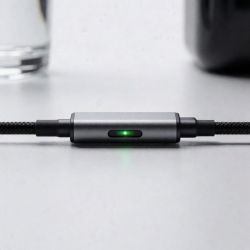
USB‑C Cable Tester (tiny) Saves Time Verifying Connections

Introducing Maria, our meticulous planner and talented visual storyteller. She has a knack for discovering those hidden gems, chic boutique spots, and charming little cafes that add a touch of elegance to every journey. With her keen eye for photography and her passion for travel, Maria will transport you to the most enchanting corners of the world, inspiring you to explore new places, one picture-perfect destination at a time.
A pocket‑sized USB‑C tester lets you map every pin and spot shorts or opens. The Treedix board shows 24 LEDs per pin, while the TRX5‑0865 displays data modes silently. If you’re after reports, the BLE caberQU syncs to your phone for voltage graphs and updates. ChargerLAB CT001 and the 240W meter draw USB‑C power, no extra battery needed. Some models reach 40 Gbps, so explore next for the best fit and what your workload demands today.
Key Takeaways
- Compact dimensions (3.54 × 3.15 × 0.94 in, 0.32 oz) make it pocket‑size and easy to carry.
- A 24‑LED matrix instantly shows continuity, shorts, open pins, and miswired contacts.
- Powerable via 5‑V USB‑C or a single CR2032, eliminating extra battery packs.
- Visual LED feedback cuts troubleshooting time from minutes to seconds.
- Acrylic housing protects the board, ensuring durability in field use.
USB Cable Tester Board with Acrylic Case

The Treedix USB‑C Cable Tester Board with acrylic case is the ideal tool for you—a field technician who’ll quickly spot cable faults with precision, in any job.
Its tiny 3.54 × 3.15 × 0.94‑in board weighs 0.32 oz, fitting in a pocket or on a bench. Powered by one CR2032 battery—or 5‑V USB‑C input, you’ll keep field work moving. The 24 LEDs map every pin, instantly flagging shorts or miswired cables across Type‑B, Type‑C, Micro‑B, Mini‑B, Lightning, and older USB ports. A robust acrylic case protects the circuitry and keeps the device compact on the go, helping you’ll save time on diagnostics and ensuring reliability.
Best For: field technicians and repair specialists who need a quick, reliable USB cable diagnostic tool on the job site.
Pros:
- Ultra‑compact and lightweight, fits in a pocket or workshop bench.
- 24‑LED pin‑by‑pin indicator gives instant visual fault detection.
- Airtight acrylic case protects the board from dust and impact.
Cons:
- Short battery life when using the CR2032 button cell.
- Lacks wireless or smartphone connectivity for remote logging.
- Slightly pricier than single‑function cable testers.

- 【Reliable USB cable tester】: The product can be used to test different types of USB cables, including TypeB 3.0, TypeB 2.0, TypeC 3.0 (TypeC 3.1/TypeC 3.2), MicroB 3.0, MicroB 2.0, MiniB 2.0, for Lightning.
- 【Convenient and practical】: The product features a portable design, compact size, and is easy to carry and use.It's comes with an acrylic case to protect the usb cable tester from damage.
- 【Multiple power supply options】: Supports two power supply modes: CR2032 button battery or Type C 5V to stably supply power to the usb cable tester
- 【LED indicator lights】: Test results are displayed through 24 LED indicators, with each pin corresponding to an LED light.
- 【Multi-functional and practical】: Supports multiple types of interfaces, allowing quick detection of data cable abnormalities and detection of internal short circuits that may interfere with normal operation.
USB Cable Tester with LED Fast Detection

When you need to spot a faulty USB‑C cable right away, this LED‑based tester instantly tells you whether each wire is intact, open, or charge‑only, making it the go‑to tool for repair shops and tech hobbyists who demand rapid, reliable checks. You’ll appreciate its 7.3 × 5.7 × 1 cm size, weighing just 1.76 oz, and its black finish. The Treedix TRX5‑0865 supports Type‑C, USB‑A 3.0, Micro‑B, Mini‑B, and Lightning, flagging normal, fault, open, charge‑only, data‑transmission, and high‑speed modes. Choose the CR2032 battery or a 5 V external supply through the Type‑C port—ideal for quick field diagnostics ensuring confidence in each repair and saving time daily.
Best For: electronics repair professionals and tech hobbyists who need rapid, reliable USB cable fault detection on the go.
Pros:
- Quick visual detection thanks to intuitive LED indicators
- Wide compatibility with Type‑C, USB‑A 3.0, Micro‑B, Mini‑B, and Lightning connectors
- Dual power options: CR2032 battery or 5 V external supply for maximum portability
Cons:
- Limited to visual LED information; lacks advanced diagnostic detail
- Small display may be hard to read under bright sunlight or glare
- Requires external power or a new battery; no built‑in charging port for continuous use

- 【High-Quality Tester】This USB cable tester is specifically designed to tackle cable clutter, enabling quick identification of various USB cable types. By observing the LED indicators on the test board, users can intuitively determine the number of wire cores and transmission performance.
- 【Extensive Compatibility】Equipped with nearly all mainstream USB interfaces—Type-C, USB-A 3.0, Micro-B 3.0, Micro-B 2.0, Mini-B 2.0, and Lightning cables—this USB cable tester can quickly detect cable status (normal/fault/open circuit/charge-only/data transmission function/high-speed data transmission, etc.).
- 【Efficient Detection】When dealing with piles of tangled cables, this USB-C tester allows you to swiftly distinguish between different USB-C cables. It is particularly suitable for electronics repair, device debugging, cable quality inspection, and similar scenarios.
- 【Dual Power Supply Methods】The USB tester offers flexible power options: it can be powered either by a CR2032 button cell battery or via a Type-C interface (Note: When using Type-C for power, a separate 5V power adapter is required).
- 【Compact Size】With its small form factor measuring just 7.3×5.7×1 cm, this USB tester is highly portable and can be carried anywhere. Please note: This device is intended solely for cable testing and must not be connected to end devices such as smartphones or computers.
BLE caberQU USB-C Cable Tester with App

For tech pros on the go, the BLE caberQU USB‑C cable tester delivers a complete diagnostic in just a few taps. You’ll see speed, power, and health on its compact screen, then explore full pin data on the second and third screens. The tester applies voltage to all 24 pins, measures max data speed up to USB4, charging current up to 5 A, and determines cable resistance. With BLE, you sync to an iOS or Android app for deeper reports, firmware updates, and eMarker info. Weighing 55 g and 3.58 × 1.85 × 0.51 in, it’s CE, FCC, and RoHS certified during daily operations today.
Best For: tech pros, field engineers, and quality‑control teams needing fast, comprehensive USB‑C cable diagnostics on the go.
Pros:
- Rapid, all‑pin voltage test delivers instant speed, power, and health metrics.
- Built‑in touchscreen plus BLE app allows deep diagnostics, firmware updates, and eMarker info right from a smartphone.
- Ultra‑compact (55 g) and CE/FCC/RoHS certified – perfect for everyday field use.
Cons:
- Supports only USB‑C to USB‑C cables; no compatibility with USB‑A or legacy connectors.
- Operating temperature range limited to 5 °C – 35 °C, less suitable for extreme climates.
- Full feature set (reports, firmware updates) relies on the companion app, with no native PC interface.
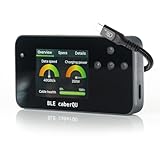
- Comprehensive USB-C Cable Diagnostics: Evaluate USB-C to USB-C cables for data transfer speeds, charging power capabilities, and overall cable health, ensuring optimal performance and safety.
- Intuitive Digital Display: Features a user-friendly screen with three main diagnostic views, providing clear insights into cable specifications and performance metrics at a glance.
- Advanced Testing Capabilities: Utilizes voltage application across all 24 USB-C pins plus Shield to assess continuity, connector pin-out, and internal resistance, aiding in the detection of damaged or subpar cables.
- Portable and User-Friendly Design: Compact form factor with straightforward navigation buttons, making it easy to carry and operate for both professionals and everyday users.
- BLE Companion App for Detailed Insights: Connect wirelessly via Bluetooth to the official BLE caberQU app (iOS & Android) for advanced diagnostics, firmware updates, and a deeper look into each cable’s properties—perfect for enthusiasts and professionals alike.
ChargerLAB Power-Z CT001 24-Pin USB-C Cable Tester

If you’re a mobile technician or gadget enthusiast needing quick, reliable diagnostics, the ChargerLAB Power‑Z CT001 USB‑C Cable Tester is the go‑to tool—its full 24‑pin continuity detection, paired with 24 vivid LEDs, instantly shows whether any pin is missing or faulty, saving you time and hassle. It plugs straight into any USB‑C cable, revealing charging and data pin statuses with single sweep. The LED set highlights loss or shorts, while software measures transfer rate, telling you if the cable supports USB 2.0, 3.0, or 3.1 speeds. Powered by CR2032 cell, it stays compact—53 mm long, 33 mm wide, 9 mm tall, and under 18 g.
Best For: mobile technicians and gadget enthusiasts who need instant, on‑the‑go diagnosis of USB‑C cable continuity and data‑transfer speeds.
Pros:
- 24‑pin LED matrix provides immediate visual confirmation of every pin’s status.
- Powered by a single CR2032 battery, keeping the tester ultra‑compact and portable.
- Built‑in data‑rate testing distinguishes between USB 2.0, 3.0, and 3.1 cables.
Cons:
- The CR2032 battery is sold separately, requiring an extra purchase.
- No accompanying software or app for detailed logging or advanced diagnostics.
- Limited to USB‑C and USB‑A to USB‑C cables, not supporting legacy connector types.

- 【Full 24-Pin Continuity Detection】Supports complete USB-C pin testing with 24 LED indicators, helping you instantly identify faulty or missing connections.
- 【Power Delivery Compatibility】Accurately checks cable continuity for charging pins, ensuring reliable charging performance.
- 【Data Transfer Verification】Detects whether your cable supports data transmission and how fast can it be.
- 【Portable & Battery-Powered】Compact design (53×33×9mm, 17.8g) powered by a CR2032 button cell, no external power required — perfect for on-the-go cable testing.
- 【Easy-to-Read LEDs & Broad Compatibility】Independent LEDs for each pin group clearly display continuity results for fast and intuitive diagnostics. Supports USB-C to USB-C cables and, with the included USB-A female to USB-C male adapter, USB-A to USB-C cables.
240W USB-C Power Meter Tester (2 Pack)

The 240 W USB‑C Power Meter Tester, sold as a two‑pack, displays voltage, current, and wattage in bright real‑time on a built‑in LED screen, so you can see power flow instantly.
With a 240‑W PD ceiling and 40 Gbps bandwidth, it auto‑adjusts output per device. Compact at 6.89 × 4.21 × 0.43 inches and only 0.352 oz, it plugs straight in—no drivers, no fuss. Each pre‑verified unit guarantees reliable readings, making it ideal for ensuring efficient charging, monitoring battery health, and troubleshooting power issues for everyday tasks and on‑the‑go use. Packaged in a sturdy shell, it includes manufacturer support and a warranty for peace of mind.
Best For: anyone who needs instant, accurate power monitoring for USB‑C devices—whether you’re charging an iPhone 15, a laptop, or troubleshooting charging issues on the go.
Pros:
- Real‑time LED display of voltage, current, and wattage for instant feedback
- Auto‑adjusts up to 240 W PD output and supports 40 Gbps data transfer for fast devices
- Ultra‑compact, lightweight design with plug‑and‑play operation—no drivers or software
Cons:
- Limited to USB‑C cables and ports; not useful for older or non‑USB‑C devices
- 240 W ceiling may be insufficient for very high‑power laptops or workstations
- Small screen may be hard to read in bright or dark environments without a flashlight

- 【Power Digital LED Display Design】This usb c voltage meter tester adapter allows you to monitor how many watts your device is passing through and keep track of its health at all times. You can also use the type c adapter to test whether the wattage used by the device when operating is optimal, so as to make effective adjustments in a timely manner.
- 【240W PD Fast Charging & 40 Gbps Data Transfer】: This usb c power meter tester adapter to will work up to 240W and totally provide the amount of power to satisfy your requirement of Macbook or other USB C device. It can automatically adjust the power output parameters according to your device need. The data transfer speed is up to 40 Gbps .
- 【Universal Compatibility】Suitable for connecting two devices with C port when wearing a phone case. Widely work with most Type C devices. For USB C cable, compatible with Chromebook, Surface Book, Macbook Pro/Air, iPad, iPhone 15 Series, PC, laptops, tablets, smartphones, etc.
- 【Highly Practical and Reliability】Small and portable. Plug and Play. No external driver or software installation needed. Each usb c tester adapter tested manually to ensure that it can work perfectly.
- 【You Can Get】2-Pack usb c tester power meter adapter.
Eversame USB-C Power Meter PD3.1 Multimeter

Need the most precise way to test USB‑C power delivery? The Eversame AT 085 delivers ±0.1 % accuracy with a 4.5–50 V DC voltage range and 0–12 A current. It supports PD 3.1 up to 48 V, PD 2.0/3.0, PPS, QC 3.0, FCP, and more, letting you test chargers, cables, power banks, laptops, phones, and wireless chargers. Its 6‑color LCD shows voltage, current, power, capacity, and CPU temp, while real‑time curves and pause‑resume capture peaks. The unit estimates internal battery capacity from high‑voltage data, and its auto‑rotate display locks after five presses. Compact (1.7 × 0.98 × 0.4 in), lightweight (0.35 oz), CE‑ and RoHS‑certified, backed by 18 months support. Use anytime, anywhere, all time.
Best For: power engineers, hobbyists, and tech reviewers who need a highly accurate USB‑C PD/USB‑C cable and charger tester in a compact, portable form factor.
Pros:
- ±0.1 % measurement accuracy across 4.5‑50 V and 0‑12 A ranges.
- Supports a wide array of PD 3.1/2.0/3.0, PPS, QC3.0, FCP, and other protocols for testing virtually every USB‑C device.
- Real‑time voltage/current curves, peak recording, and internal battery capacity estimation for advanced diagnostics.
Cons:
- Limited to 48 V / 12 A; not suitable for higher‑spec chargers or industrial power supplies.
- Requires external power to operate; no built‑in battery for extended field use.
- No wireless data export—data must be viewed directly on the small LCD.

- 【Multifunctional USB-C Power Meter】 Designed to detect the charging status and process of USB-C devices. Supports PD3.1 48V, PD2.0, PD3.0, PPS, OC2.0, QC3.0, FCP, SCPAFC, PE, DASH VOOC, SuperV00C and more protocols. Support to detect charging performance of USB-C chargers, cables, power banks, wireless chargers, laptops, smartphones, and other USB-C devices. With a measurement accuracy comparable to professional-grade instruments at ±0.1%, it is an essential tool for testing USB-C ports
- 【Multiple Color Display Modes】 Upgraded version offers 6 LCD primary color display interfaces, support to monitor real-time voltage, current, capacity, power, and CPU temperature of USB-C devices, while also recording peak current/voltage/power and time.Real-time voltage and current curve page allows you to instantly observe fluctuations and changes during charging; To analyze the curve over a specific period, you can long-pressing the confirmation key on this page to pause and resume the curve
- 【Battery Capacity Calculation】According to the step high-voltage charging power quasi-value data for the battery voltage and conversion rate of the logic through the software to calculate the internal battery capacity of the device, to avoid the high-voltage test can not be tested due to the disadvantages of the battery capacity of the machine, so as to accurately derive the value of the internal battery capacity of the device, and the battery capacity of the device
- 【Real-Time Peak Value Recording】 AT085 USB-C tester allows you to check the max-voltage, max-current, and max-power values during charging period, easily to determine the extreme charging power of phones, chargers, power bank etc. The AT085 USB-C tester adds a gravity acceleration sensor and the display can automatically rotate the screen in 4 directions to provide you with the better reading experience(Note: Press the confirmation button 5 times consecutively to enter direction lock mode)
- 【Our Commitment】 Included: 1 USB-C tester in champagne gold. We are committed to maintaining and continuously improving product quality. We believe in our products, which is why we offer an 18-month worry-free service. If you are not satisfied with our product for any reason, please feel free to contact our support team
YOJOCK USB-C 2-in-1 Power Meter

When you need instant, reliable data from every charging standard in your kit, the YOJOCK USB‑C 2‑in‑1 Power Meter delivers it—measuring up to 32 V and 8 A in real time while cycling through eight selectable modes on an 8‑color IPS display. You’ll see voltage, current, power, temperature, resistance, charge time, energy, and load impedance with 0.01 accuracy. Eight modes—including a large‑font view—give reads. It supports PD3.0/2.0, QC3.0/2.0, BC1.2, and USB‑A/USB‑C, plus an OTG adapter. The 40‑gram unit works with iPhones, MacBook Pro, Dell XPS, Surface Pro, and Razer Blade. Over‑voltage, over‑current, low‑energy protection auto‑cuts, and data saves if power drops. CE‑and RoHS‑certified, it’s battery‑free.
Best For: Engineers, tech enthusiasts, and power‑charging professionals who need quick, accurate, and versatile real‑time power metrics across multiple USB standards on the go.
Pros:
- Ultra‑compact 40 g design with an intuitive 8‑color IPS display for instant data.
- Supports a wide array of fast‑charging protocols (PD3.0/2.0, QC3.0/2.0, BC1.2) and both USB‑A and USB‑C inputs.
- Includes built‑in safety features (over‑voltage, over‑current, auto‑cut‑off) and saves data during abrupt power loss.
Cons:
- No manufacturer warranty disclosed, potentially limiting post‑purchase support.
- Limited to measuring up to 32 V and 8 A, which may not cover all high‑power devices.
- Absence of a calibration or service manual could hinder precise long‑term use.

- 【Upgraded Multifuntional USB C Power Meter】The USB tester can detects Voltage, Current, Capacity, Electric Quantity, Power, Temperature, Resistance, Charging Time and other data of the USB or type C Port Devices. A Must Gadget checks the charging performance(charging speed and quality) of the output wall/car/solar panel chargers and USB charging cables. It can be also used to test capacity and electric energy of power bank. Measuring voltage: 3.6V-32V; measuring current: 0-8.0A.
- 【Latest Upgraded IPS Color Display Screen】New upgraded version offers 8 IPS main color screen display interfaces, allowing switching the display interface by pressing the key. The fonts are larger in one mode, which can read the data at a glance and facilitate viewing. This instrument can monitor Voltage, Current, Capacity, Electric Quantity, Power, Load Impedance, ect..
- 【Wide Range of Application】The USB power meter comes with A OTG adapter, supports PD3.0/PD2.0, QC3.0/QC2.0, BC1.2 and USB A or USB C port, supports the updated iPhone 13 Pro mobile phone. (Support iphone 13/12/11/X/iPhone Xs quick charging, 29W power, 5V3A/9V3A/12V2.5A/15V2A). Compatible with new MacBook Pro, MacBook, iMac, iMac Pro, Dell XPS, Acer Aspire, HP Spectre, Lenovo Thinkpad, Eluktronics, Razer Blade Stealth, Chromebook, Microsoft Surface Pro and more Type C devices and chargers.
- 【Test Power Bank Capacity】Before testing the power Bank,please fully charge the power bank,insert the usb voltage tester and double-click to clear the data,then connect the load or mobile phone (continuous discharge is required).ensure that the discharge voltage is 5V or 9V.(mAh is multiplied by 1.35 when discharge voltage 5V, and mAh is multiplied by 2.45 when discharge voltage is 9V, which is equal to the exact capacity of the battery of the power bank.)
- 【Professional Safety Guard】This USB C tester featured with over-voltage protection, over-current protection, under-voltage protection, low energy protection. This upgraded USB Type C tester can detect safety and maximally protect the appliances from damaging. It will cut off output automatically, while it will save data when power off suddenly.
Teyleten 3pcs USB-C & Micro USB Cable Tester

If you’re a responder who needs to pinpoint cable faults on the fly, the Teyleten 3‑piece USB‑C & Micro‑USB tester gives you instant feedback with four LED indicators—every LED lit means a solid link, while one to three lit flags a problem. This compact board, part of a three‑unit set, checks Lightning, USB‑C, Micro‑USB, and USB‑A lines. Place the power source, insert the cable into the matching port, and observe. All four LEDs on a standard USB‑C or five on dual‑head Type‑C confirm normal power, while fewer lights signal an issue. Weighing just 1.38 oz and measuring 5.91 × 3.94 × 0.59 in, it’s portable, easy to handle, and perfect for fast‑charging diagnostics starting November 15 2024.
Best For: tech professionals and DIY enthusiasts who need rapid, on‑the‑fly cable diagnostics for USB‑C, Micro‑USB, Lightning, and USB‑A connections.
Pros:
- Compact, lightweight design (5.91 × 3.94 × 0.59 in, 1.38 oz) for easy portability.
- Four LED indicators provide instant visual feedback on power supply integrity.
- Includes a separate board for each cable type, covering Lightning, USB‑C, Micro‑USB, and USB‑A.
Cons:
- Limited to visual LED output, no digital readout or error codes.
- No stated voltage or current measurement specifications for detailed diagnostics.
- Availability only through select retail or online channels; no public price or warranty details.

- 1:Lightning USB
- 2:Micro USB
- 3:USB-A
YOJOCK USB‑C Power Meter 4‑30V 0‑6.5A

This compact 40‑gram tester lets you quickly gauge voltage, current, and power while also snapping temperature, resistance, and charging‑time data—all in a single display. You’ll see 4 V to 30 V readings, 0 A to 6.5 A currents, and wattage up to 195 W instantly. One press cycles display modes, double‑tap rotates content, and a three‑second hold wipes past data. After power‑off, it stores capacity and energy totals for later review. Compatible with QC2.0/3.0/4.0, VOOC, and other fast‑charge protocols, it fits tight on desks or in pockets. The sleek black or silver casing weighs just 40 g, making on‑the‑go diagnostics effortless every single time, effortlessly daily.
Best For: electronics hobbyists, tech reviewers, and anyone needing quick, reliable USB‑C power‑metering on the go, especially when testing QC/VOOC fast‑charging setups.
Pros:
- Small, lightweight (40 g) and portable design fits desks and pockets.
- Wide voltage (4‑30 V) and current (0‑6.5 A) range with instant power display up to 195 W.
- Smart data handling: storage of capacity, energy, and auto‑clear function for hassle‑free workflow.
Cons:
- Limited to USB‑C inputs; not compatible with Type‑A or other connectors.
- No communication (Bluetooth, Wi‑Fi) or software integration for remote monitoring.
- Protocol name detection hidden, so users may need to infer the charging protocol manually.

- Multi-function: This USB tester is designed to detect voltage, current, capacity, electric quantity, power, temperature, resistance, charging time and other data of the USB C devices, which is convenient for testing power supply and quality.
- Detect Various Fast Charging Protocols: The Type-C USB tester supports QC2.0/3.0/4.0 and Super VOOC protocol charging, but the name of the fast charging protocol will not be displayed on the USB tester.
- Measuring Data is Guaranteed: Power-off storage function that stores capacity and energy data when the mobile power is turned off, which is convenient for subsequent viewing and convenient for capacity energy measurement of mobile power.
- Wide Applicability: This USB C Tester Measuring voltage: 4V-30V; measuring current: 0-6.5A. YOJOCK Tester are widely used in the quality inspection of 3C digital peripheral products, and are the first choice for digital gamers and electronic enthusiasts.
- Button Function: 1.Click the button once to switch screens in a cyclical manner; 2.Double-click the button to rotate the displayed content; 3.Press and hold the button (3 seconds): Clear all capacity, amount of electricity, and time.
diymore USB-C Power Meter & Multimeter

The diymore USB‑C Power Meter delivers instant, accurate readings for anyone who needs to verify the performance of USB‑C peripherals. It measures voltage, current, power, resistance, temperature, charging time, and capacity, covering every metric you’ll need during testing. With a 4 V–30 V voltage range and a 0 A–6.5 A current span, the meter stays accurate within ± 1 %, certified by NIST and EN 61010‑1 compliance. Its compact 5.68 cm × 2.58 cm body and 0.02 kg weight let you ship it in any pocket without compromising visibility. The bright LED display shows real‑time metrics and stores multiple test sets; it even auto‑saves data when power cuts out for safety.
Best For: engineers, hobbyists, and tech enthusiasts who need quick, accurate USB‑C measurements for testing and development.
Pros:
- Provides voltage, current, power, and additional metrics with ± 1 % accuracy, certified by NIST and EN 61010‑1.
- Compact 5.68 cm × 2.58 cm, lightweight 0.02 kg design plus a 14 cm extension cable for flexible measurement points.
- Stores multiple test sets on a bright LED display and auto‑saves data during power loss for safety.
Cons:
- Designed exclusively for USB‑C; not compatible with older USB types.
- Lacks wireless connectivity or export options for automated data analysis.
- Small LED display can be difficult to read in very bright or glare‑heavy environments.

- The current and voltage charging tester supports voltage 4-30V, 0-6.5A test voltage.
- The size of the USB tester is 5.68*2.58cm (2.24*1.02inch) with a 14cm Type C extension cable.
- Multi-function: This USB tester is designed to detect voltage, current, capacity, electric quantity, power, temperature, resistance, charging time and other data of the USB C devices, which is convenient for testing power supply and quality.
- The charging tester supports multiple sets of test data saving, and the power failure saving function does not affect the data transmission.
- The Type C voltage tester can measure the power supply or power consumption of USB interface, cell phone charger, USB flash disk and other products, easy to measure the working voltage and current of USB port and device output voltage.
Diymore Type-C USB Tester & Multimeter QC/PD

Looking for a single tool that instantly shows you a cable’s voltage, current, internal resistance, and even its USB‑PD or QC data, the Diymore Type‑C USB tester answers that call.
Grab it, plug your cable in, and the 1.77‑inch TFT display blinks real‑time voltage, current, and power readings with ±0.1 V and ±0.01 A precision. The tester also decodes USB‑PD 3.1 and QC 2.0/3.0 protocols instantly, giving you charging profiles and voltage allowances. Its pressure‑difference method reveals internal resistance, so you can spot weak links before they fail. Lightweight—just 1.23 oz—and compact at 3.94×2.56×0.59 inches, it fits in your pocket, making on‑the‑go checks effortless.
Best For: professional technicians, electronics hobbyists, and everyday consumers who need instant, accurate cable diagnostics and USB‑PD/QC protocol insights on the go.
Pros:
- Accurate real‑time measurements (±0.1 V, ±0.01 A) with instant protocol decoding.
- Ultra‑compact, lightweight design (3.94×2.56×0.59 in., 1.23 oz.) that fits in any pocket.
- One‑hand operation featuring a clear 1.77‑inch TFT display and seven selectable modes.
Cons:
- Limited to USB‑C cables only; no support for older USB‑A or micro‑USB formats.
- Measurement range capped at 25 V for voltage, which may be insufficient for high‑voltage industrial cables.
- No accompanying mobile app or data export functionality for advanced analysis.

- High-Definition Display: 1.77-inch TFT screen shows real-time voltage, current, power, and charging data with exceptional clarity for easy monitoring
- Multi-Protocol Support: Compatible with PD and QC2.0/3.0 charging protocols, ensuring wide device compatibility and versatile testing capabilities
- Comprehensive Measurements: Monitors voltage (4-25V), current (up to 6.5A), power output, and charging protocols with 0.1V/0.01A accuracy
- Customizable Interface: Features 7 different display interfaces for viewing various charging parameters and statistics to suit different testing needs
- Advanced Diagnostics: Measures wire internal resistance using pressure difference method, helping evaluate charging efficiency and cable quality
diymore USB-C Power Meter Tester with LED Display

Need an ultra‑light, on‑the‑go solution to verify USB‑C cables and chargers?
diymore’s USB‑C Power Meter Tester weighs 8 g, measuring 5.63 × 3.62 × 0.35 in.
Solar power lets it run from 4 V to 30 V; it measures currents up to 12 A and shows power up to 240 W.
The LED screen displays voltage, current, power, temperature, and session stats like working time and max values.
It lists supported protocols—PD 2.0/3.0, PPS, QC 2.0/3.0, FCP, SCP, AFC, PE, DASH VOOC, Super VOOC—plus a data‑logging chip that auto‑restores every session.
For bank tests, charge the bank, double‑click the meter to wipe data, then attach your phone and let it discharge for runtime.
Best For: technicians and power‑bank enthusiasts who need quick, on‑the‑go USB‑C voltage, current, and power measurements without a bulky setup.
Pros:
- Ultra‑light 8 g form factor for true portable use.
- Supports a wide array of charging protocols (PD 2.0/3.0, PPS, QC, VOOC, etc.) with real‑time data logging.
- LED display shows voltage, current, power, temperature, working time, and max values all in one glance.
Cons:
- Limited to 4 V–30 V input, so it can’t measure lower‑voltage Li‑ion cells directly.
- Relies on solar or external power; no internal battery means it may need to be plugged in in dark environments.
- Tiny LED screen can be hard to read in bright sunlight or under very strong ambient lighting.

- 240W USB C Power Meter: The digital multimeter USB tester can check the charging performance of the output wall/car/solar panel charger and USB charging cable. Measurement voltage: 4V-30V; Measurement current: 0-12A.
- Support for Additional Charging Protocols: The usb power meter supports charging protocols such as PD2.0, PD3.0, PPS, QC2.0, QC3.0, FCP, SCP, AFC, PE, DASH VOOC, Super VOOC.....
- USB C Tester 9 Parameters: The usb cable tester not only displays instantaneous voltage, current, power, and temperature, but also counts the continuous working time, consumed power, as well as the maximum voltage, maximum current, and maximum power during the entire charging process.
- Power Bank Capacity Power Consumption Meter: Before usb meter testing the power bank, please fully charge it, insert it into the USB C meter, double-click to delete data, and then connect the phone (continuous discharge is required).
- USB C Voltage Meter Storage Function: The USB C meter tester has an integrated storage chip. If the connection is accidentally disconnected during the testing process,the previous test data can be automatically restored after reconnecting.
USB-C 3-in-1 Tester with IPS Screen

Want real‑time insights into your USB‑C chargers, cables, and batteries? The AVHzY UD18 is a 1.97 × 1.97 × 0.39‑inch, 34‑gram tester that fits in your pocket. Its IPS display flips, shows voltage, current, power, resistance, and capacity with ±0.00001 V/C accuracy, even detecting two‑way current and energy capacity. It supports USB, Type‑C, DC5.5, micro‑USB, and recognizes PD 2/3 and QC 2/3 chargers, while safeguarding against over‑voltage, over‑current, and overheating up to 60 °C. Connect via the companion app for graphs and data export, and use the clip and load for quick, reliable checks on notebooks, routers, and emergency car power on your devices daily, stay efficient always.
Best For: travelers, tech enthusiasts, and professionals who need quick, portable diagnostics for USB‑C devices on the go.
Pros:
- Precise ±0.00001 V/C measurement of voltage, current, power, resistance, and capacity, including two‑way current detection.
- Compact IPS screen that flips for easy viewing and app‑connected graphs and data export.
- Versatile connectivity (USB, Type‑C, DC5.5, micro‑USB) and automatic recognition of PD 2/3 and QC 2/3 fast‑charging protocols.
Cons:
- No temperature probe provided, limiting thermal diagnostics.
- Battery‑powered with a minimum 3.6 V requirement, which may require frequent recharging on extended use.
- Limited to charging‑related measurements; lacks advanced battery health metrics found in dedicated battery analyzers.
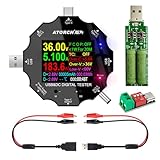
- High PrColor screen - 8 interfaces - Support USB, Type-C, DC5.5, micro USB. It can measure the voltage and current changes during the operation/charging process of various DC inverters such as mobile phones, notebooks, desk lamps, routers, set-top boxes, etcracy display. Its measurement accuracy reaches 0.00001.
- Wide Applications:With the USB tester, you are able to test notebooks, car emergency power supplies, routers and other DC products, monitoring current, voltage, power, capacity, power and other state of charge in real time.
- The tester and mobile phone enable to realize APP. And charging status, various measurement data & graph can be transmitted and viewed on your phone. You can switch different measurement interfaces by pressing the button.
- Multi Functions:Functions include screen flip, fast charge recognition, energy capacity detection, temperature measurement, accuracy measurement, two-way current measurement and other data tests(temperature probe is not included).
- Safety Protection:Featured with over-voltage protection, over-current protection, low-voltage protection, charging time setting and auto-off function, the meter can detect safely and maximally protect the appliances from damaging.
Cablecc USB-C Voltage Current Tester

If you’re a digital gamer or electronics hobbyist who demands instant, reliable power insights, the Cablecc UC‑174‑CC pulls out all stops. This tiny black tester weighs just 0.03 kg and measures 6.89 × 4.21 × 0.51 in, making it easy to carry. It tackles voltage from 4 to 30 V and current up to 6.5 A, while detecting power, watt‑hour, capacity, charge time, temperature, and resistance. A single‑button toggle cycles power, watt‑hour, and capacity displays, and a 3‑second press clears timing data. It auto‑stores readings every 30 s, even when powered off. Compatible with QC 2.0/3.0/4.0 and Super VOOC, it’s perfect for testing 3C accessories daily.
Best For: Digital gamers and electronics hobbyists seeking instant, reliable USB‑C power insights on the go.
Pros:
- Ultra‑compact and lightweight (0.03 kg) for easy carry.
- Broad measurement range: 4‑30 V, 0‑6.5 A, plus power, watt‑hour, capacity, temperature, and resistance.
- Smart auto‑memory and quick‑clear feature; updates data every 30 s even when powered off.
Cons:
- Minimum operating voltage starts at 4 V, limiting use with lower‑voltage devices.
- Requires an external power source (corded, no battery backup).
- Lacks a display of the exact charging protocol (only shows QC 2.0/3.0/4.0 compatibility).

- 1) Multi-function: This USB tester is designed to detect voltage, current, capacity, electric quantity, power, temperature, resistance, charging time and other data of the USB C devices, which is convenient for testing power supply and quality.
- 2) Button Function: Click the button to view the power, Watt hour, and Capacity. Hold the button for 3 seconds to clear all the data oftiming,Watt hour, Capacity, etc. The product has automatic memoryfunction when power off. The data can be saved every 30 seconds after power off.
- 3) Detect Various Fast Charging Protocols: The Type-C USB tester supports QC2.0/3.0/4.0 and Super VOOC protocol charging, but the name of the fast charging protocol will not be displayed on the USB tester.
- 4) Wide Applicability: This USB C Tester Measuring voltage: 4V-30V; measuring current: 0-6.5A. The Tester are widely used in the quality inspection of 3C digital peripheral products, and are the first choice for digital gamers and electronic enthusiasts.
- 5) Measuring Data is Guaranteed: Power-off storage function that stores capacity and energy data when the mobile power is turned off, which is convenient for subsequent viewing and convenient for capacity energy measurement of mobile power.
Klein ET920 USB Power Meter

When you need a rugged, battery‑free meter that logs 1,000 hours of voltage and current data, the Klein ET920 fits the job for field technicians, hobbyists, and anyone who must verify that a USB‑C supply stays within safe limits.
With voltage ranges from 3 V to 20 V and current up to 5 A for USB‑C, it measures everything you need. It logs voltage, current, capacity, energy, and calculated resistance for 1,000 hours, storing ten snapshots for quick comparison. Passive operation draws power from the source, eliminating batteries. The high‑resolution LCD remains readable in low light, and its drop‑proof 1.7‑oz body endures rough job sites.
Best For: field technicians, hobbyists, and anyone who needs a rugged, battery‑free USB power meter to verify safe voltage and current limits on the job site.
Pros:
- Rugged, drop‑proof design suitable for tough job sites.
- Passive, battery‑free operation powered directly by the USB source.
- Long‑term logging for up to 1,000 hours with convenient snapshot storage.
Cons:
- Limited to USB‑A and USB‑C; not compatible with older or proprietary connectors.
- No built‑in data export; relies on manual reading or external logging.
- Size and weight (1.7 oz) may be noticeable for very compact field setups.

- VERSATILE USB TESTING: Test voltage from 3 to 20V DC and current from 0.05 to 3A (USB-A) and current from 0.05 to 5A (USB-C), covering most common standard USB ports, including Qualcomm Quick Charge ports
- EXTENSIVE MONITORING: Continuously monitor voltage, current, capacity/charge delivered, energy, and resistance (calculated) for up to 1000 hours, providing comprehensive data insights
- CONVENIENT DATA STORAGE: Store and recall up to 10 readings, allowing easy access to previous measurements for comparison and analysis
- OVERLOAD DETECTION: Detect voltage and current overload, ensuring the safety and protection of your devices and power sources during testing
- HIGH-RESOLUTION LCD: The hi-resolution LCD provides clear visibility of measurements, even in environments with low ambient lighting, ensuring easy reading of data

Factors to Consider When Choosing USB‑C Cable Tester (Tiny)
When you pick a tiny USB‑C cable tester, keep its compact size and portability in mind.
You’ll want accurate LEDs, flexible power options, and broad compatibility with different cable types and voltage ranges.
It should also be built to last, so check the materials and overall durability.
Size and Portability
A lightweight tester keeps your kit minimal and lets you test cables on the fly. Because it weighs under 25 g (about 0.88 oz), you can slip it into any pocket without adding bulk. Its dimensions—roughly 3.5 in by 2.5 in and only 0.5 in thick—ensure it fits in even the smallest compartments. Powering solely from a CR2032 button cell or a USB‑C 5 V input means no bulky adapters, keeping the design ultra‑compact. A slim, rectangular or cylindrical body with a width under 2 in lets you grip it comfortably with one hand. Attach a detachable 6–8 in extension cable to reach remote ports without expanding the tester’s footprint. Drop‑proof, shock‑resistant housings keep the total weight below 50 g, ensuring field durability while staying portable. Perfect for on‑the‑go troubleshooting daily anytime, anywhere.
LED Indicator Accuracy
Since you’ve already appreciated the tester’s sub‑25 g portability, the next factor that matters is the LED indicator accuracy. A 1:1 LED mapping—24 individual LEDs for the 24 USB‑C pins—lets you pinpoint precisely which pin is shorted, open, or correctly connected. Separate LED groups for power‑delivery pins (VBUS, GND) and data pins give instant visual confirmation of charging capability versus data transfer status. High‑brightness LEDs with rapid turn‑on response eliminate misreading caused by delayed current flow, enhancing overall reliability. LED‑based continuity checks hit micro‑ampere resolution, flagging faults quickly that would otherwise need a multimeter. Simplicity reduces user error, ensuring consistent accuracy in field diagnostics. These precise LEDs let you save time, reduce guesswork, confidently certify cable integrity before shipment to meet industry standards as well.
Power Source Options
Your choice of power source defines how portable and reliable your tiny USB‑C tester will be. If you go with a single CR2032 button‑cell, you’ll enjoy unprecedented portability, but the battery will drain after a few test sessions, forcing you to replace it. Dual‑mode units mix that button‑cell with an external 5 V USB‑C supply, so you can keep the tester running during long walks or bypass the battery entirely for maximum uptime. Fully electrical testers ditch batteries entirely, drawing power from the cable you’re testing; they’re lighter yet need a 5 V source to work. Check the tester’s minimum voltage requirement—usually 3 V or 4 V—because devices that need ≥5 V won’t function on a low‑voltage battery alone. This choice will shape your testing routine, balancing convenience against endurance daily.
Compatibility Range
Choosing a power source sets a baseline for portability, but the real test is how broadly the unit can interrogate cables of different standards.
You need a tester that reads all 24 pins on a USB‑C 3.0‑3.2 cable, including eMarker pins for USB‑4 and other high‑speed data paths.
It should also support legacy connectors—USB‑A, USB‑B, Mini‑B, Micro‑B, and Lightning—to cover old accessories and adapters.
Testing 5 V and up to 48 V lines lets you verify charger and docking‑station cables for laptops and high‑power devices.
A full pin‑out check on Type‑C guarantees proper continuity of power, ground, data, and shield, preventing hidden shorts or broken contacts.
By detecting every pin, including eMarker, you verify both low‑power USB‑A adaptors and high‑power PD cables seamlessly.
And spot faults.
Build Quality and Durability
The build quality of a tiny USB‑C cable tester hinges on how well its chassis protects the internal electronics while remaining ultralight. Because the device must stay portable, designers handpick materials that offer a balance. On‑board acrylic or sturdy hard‑shell cases give you abrasion‑resistant coverage without thickening the form. A slim footprint—roughly 3.5 × 3.1 × 1 in—lets you tuck it into tight cable straps or toolboxes, and a weight under 20 g keeps you won’t notice it. Battery‑powered models usually run on a single CR2032 cell, a tiny cell that can be swapped on the fly, maintaining a thin profile. Internally, the LED logic and PCB are shielded and mounted on a robust substrate, guaranteeing repeatability across dozens of test cycles. This construction keeps you confident that tests stay accurate chronically each time.
Frequently Asked Questions
Can the Tester Detect Ground Faults in a Usb‑C Cable?
Yes, the tester can spot ground faults while you’re checking a USB‑C cable. It swipes each pin, measures continuity, and flags any short between the ground conductor and other wires right away. That means when you plug the tester in, you’ll instantly see a ground‑fault alert if the cable’s shield or ground pin is compromised. It helps you cut down time and improve reliability for your future projects and troubleshooting.
Is the Tester Compatible With USB4 Cables?
Picture the tester as a speck of grit, catching light between a USB‑C cable’s twists, yet it misses the symphony of USB4’s ten‑gig‑plus pulses. In short, it works only for standard USB‑C and USB‑3.1; it can’t probe the high‑speed lanes or Thunderbolt essentials of USB4. So while you’ll see a physical connection, you won’t get true USB4 validation. Your everyday checks will reveal continuity, but diagnostics remain out of reach.
How Long Does the Tester’s Battery Last?
Your tester’s battery lasts about fifteen hours on full testing mode, or up to a week if you’re only checking occasional cables. When you run it continuously, you’ll find the internal lithium‑ion pack holds enough charge to keep you testing without interruption for around fifteen hours. If you plug it into power, it can even recharge while you’re on the go, boosting endurance without you noticing and keep working daily.
Does It Support Data Integrity Checks?
Yes, it does support data integrity checks, and as the adage goes, actions speak louder than words, you’ll quickly confirm each cable’s true performance. The tester reads full data streams, flags misaligned packets, and reports errors over its clear display. It’s handy for on‑the‑spot diagnostics, saving you time and effort, especially when you’re troubleshooting a tight fit or a costly prime cable. In your station or projects, it cuts headaches.
Can It Be Used With Wireless Charging Modules?
No, you’ll find that the tiny tester isn’t designed to interface with wireless charging modules. Its pins expect direct USB‑C power and data lines, and there’s no magnetic coupling or inductive circuitry built in. Trying to pair it to a Qi coil won’t produce a valid signal, and it could even damage the unit. Stick to wired checks, and use a dedicated wireless charger tester to verify proper operation today.
Conclusion
You know the drill when it comes to checking USB‑C cables—just a quick slip on the tester, and you’ll see the verdict in seconds. You’ll save time, avoid costly mistakes, and keep your gear humming. Remember, a tiny tester can be your digital Swiss army knife, turning guessing games into clear results, all while feeling oddly like your 90’s gaming console is also validating lightning‑fast data, and cables ready for tomorrow’s next‑gen tech awesomeness ahead.
time saving, tiny cable tester, USB‑C tester